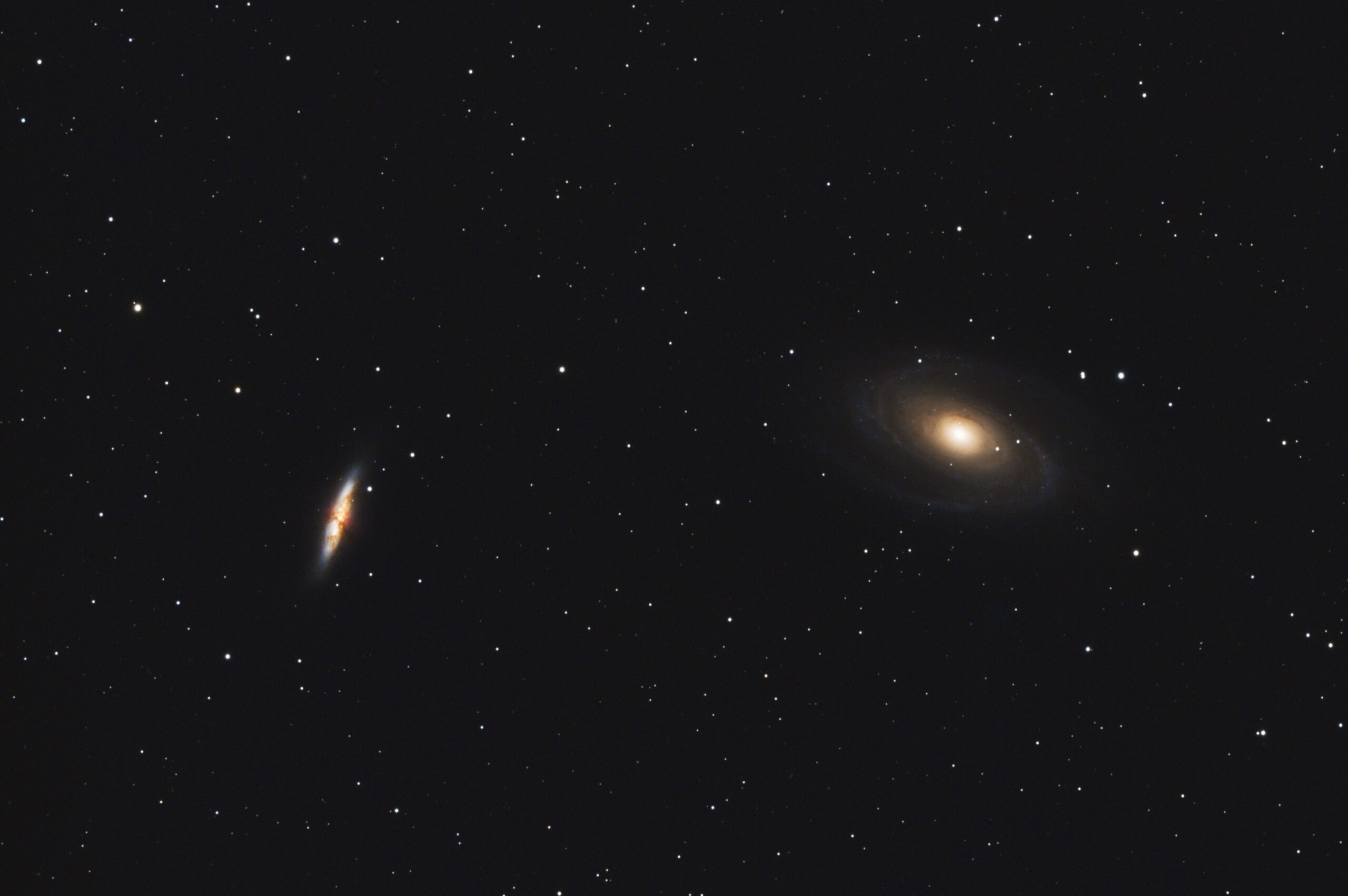
M81 & M82
The night of May 2, 2026 provided stable atmospheric conditions with good transparency, enabling high-quality acquisition of deep-sky data in the region of Ursa Major. The session was conducted from a terrace location with an unobstructed view toward the south–west and northern sky, under moderately dark conditions (Bortle ~4).
This imaging run focused on the interacting galaxy pair M81 and M82, capturing both large-scale structure and fine internal detail within a wide-field composition.
Instrumentation and Imaging Configuration
Optical system:
- Telescope: Askar 120 APO refractor
- Focal length: ~672 mm (with 0.8× reducer)
- Focal ratio: f/5.6
Imaging camera:
- ZWO ASI2600MC (Sony IMX571, one-shot color)
- Pixel size: 3.76 µm
Mount and tracking:
- Mount: Sky-Watcher EQ6-R Pro
- Guiding: ASI220MM Mini + William Optics Guidestar 61
Astrometric solution:
- Image scale: 1.159 arcsec/pixel
- Field of view: 2°00′ × 1°20′
- Image center: RA 09h 55m 32.65s / DEC +69° 04′ 06.37″
Data Acquisition
- Exposure time: 240 seconds per frame
- Number of frames: 60
- Total integration time: 14,400 seconds (4 hours)
Camera settings:
- Gain: 100
- Offset: 60
- Temperature: -10°C
Calibration:
- Dark frames matched to exposure and temperature
- Flat frames acquired with uniform illumination
- Dark flats applied for calibration accuracy
Guiding performance:
- Total RMS: ~0.31 arcsec
- RA: ~0.26″
- DEC: ~0.18″
Guiding precision remained well below the imaging scale, ensuring accurate tracking and minimal star distortion.
Data Processing Workflow (Siril 1.4.2)
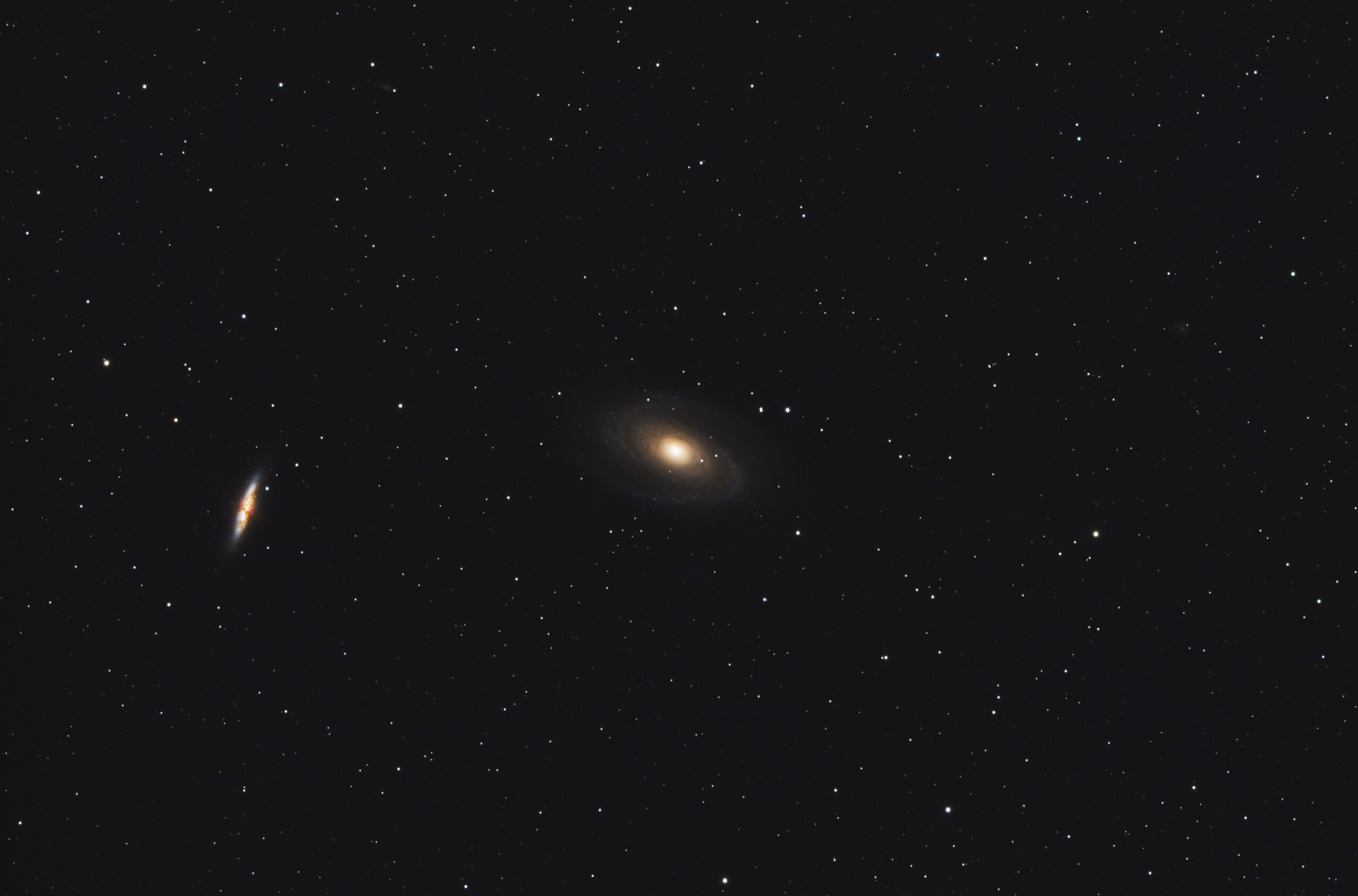
The dataset was processed using a physically consistent and photometrically accurate workflow:
- Calibration with dark, flat, and dark flat frames
- Registration and stacking of 60 frames
- Integration method: Winsorized Sigma Clipping
- Normalization: additive + scaling
- Background extraction using RBF interpolation
- Astrometric plate solving based on Gaia DR3
- Spectrophotometric Color Calibration (SPCC)
- Reference stars: 665
- Residual error: σ ≈ 0.03
- Non-linear transformation using Asinh stretch and histogram refinement
- Subtle noise reduction
- Local contrast enhancement and detail refinement
Color Calibration
Color calibration was performed using Spectrophotometric Color Calibration (SPCC) with Gaia DR3 as the reference catalogue.
The calibration utilized 665 stars and achieved a low residual error (σ ≈ 0.03), ensuring physically accurate color reproduction across the entire field. The resulting white balance coefficients preserved realistic stellar colors and natural galactic tones without artificial enhancement.
Target Objects
Messier 81 – Bode’s Galaxy
Messier 81 is a grand-design spiral galaxy located approximately 11.8 million light-years away in the constellation Ursa Major. It is classified as type SA(s)ab and represents one of the most structurally well-defined spiral galaxies observable from the northern hemisphere.
Its key characteristics include:
- a bright, yellowish central bulge composed of older stellar populations
- clearly defined spiral arms containing regions of active star formation
- a relatively stable and symmetric structure
In broadband imaging, the central region appears warm and luminous, while the spiral arms exhibit a subtle bluish tone associated with younger stellar populations.
Messier 82 – The Cigar Galaxy
Messier 82 is an irregular starburst galaxy located approximately 12 million light-years away. Unlike the structured appearance of M81, M82 is dynamically disturbed and exhibits intense star formation activity.
Its defining properties include:
- classification as a starburst galaxy
- extremely high star formation rate, significantly exceeding that of the Milky Way
- strong galactic winds (superwinds) driven by stellar feedback
- complex dust structures and turbulent internal morphology
The galaxy displays characteristic elongated geometry and chaotic internal structure, with visible dust lanes and emission regions associated with active processes.
The M81–M82 System
M81 and M82 form a gravitationally interacting pair within the M81 Group. Their mutual interaction has led to:
- tidal distortions, particularly visible in M82
- enhanced star formation activity
- redistribution of intergalactic gas
This interaction makes the pair not only visually compelling but also scientifically significant in the study of galaxy evolution and interaction dynamics.
Final Result and Assessment
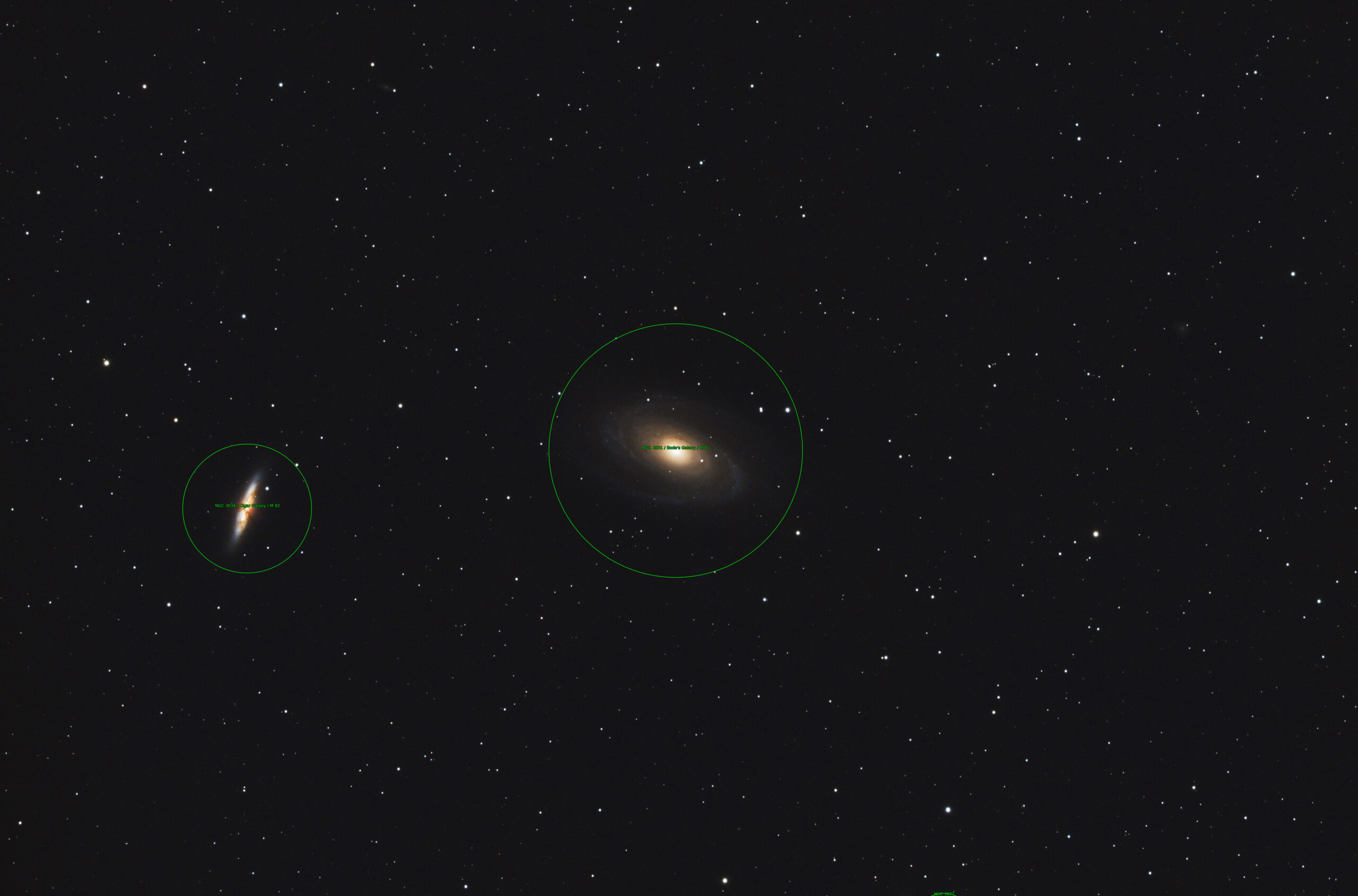
The final image reveals:
- well-resolved spiral structure in M81
- detailed internal features in M82
- accurate stellar color distribution
- a rich background populated with faint galaxies
The combination of stable guiding, sufficient integration time, and rigorous calibration produced a dataset that maintains both scientific accuracy and visual depth.
Conclusion
This session demonstrates the effectiveness of a controlled astrophotography workflow, integrating precise tracking, optimized exposure strategy, and advanced photometric calibration.
The result is a balanced representation of the M81–M82 system, capturing both the structural complexity of the galaxies and the broader cosmic environment in which they reside.