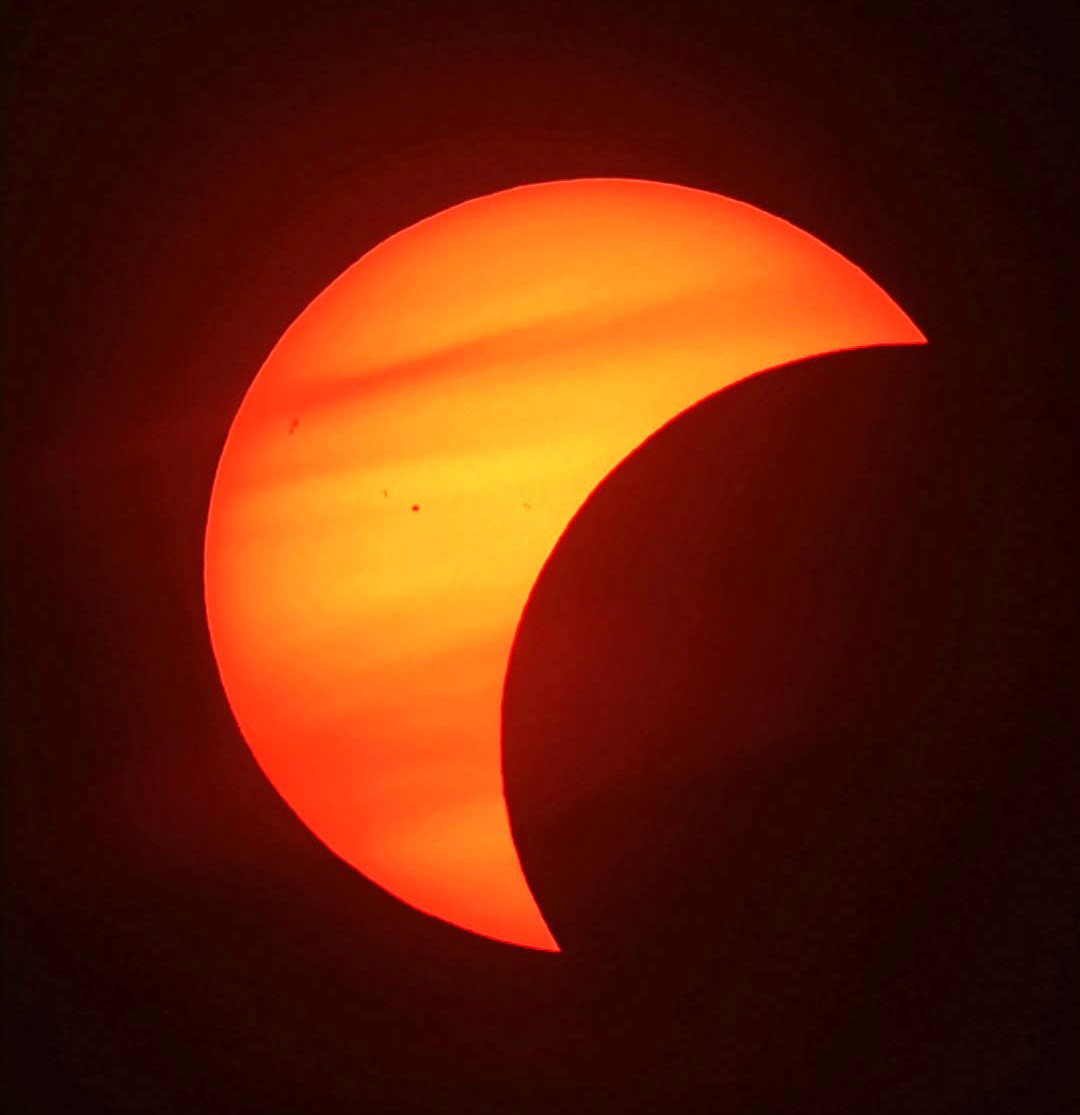
Deep Partial Solar Eclipse
On August 12, 2026, a deep partial solar eclipse was observed from Pobiedziska, Poland, as the Moon passed directly between Earth and the Sun.
The event was captured using a Seestar S50 equipped with a dedicated solar filter, documenting the heavily eclipsed solar disk during the final stages of the event, shortly before sunset.
From Pobiedziska, the partial eclipse began at approximately 19:14 CEST. The Sun was already relatively low above the western horizon, making the observation progressively more challenging as the eclipse developed.
The local maximum occurred at approximately 20:07 CEST, when the Moon covered about 86% of the solar disk. At this point, the Sun was only around 1° above the western horizon, producing a particularly demanding observing geometry.
The extremely low solar altitude significantly increased the atmospheric path length through which the sunlight had to travel. Atmospheric extinction, turbulence and differential refraction therefore became important factors affecting image quality. Despite these conditions, the Seestar S50 was able to record the characteristic crescent-shaped solar photosphere with the lunar disk obscuring the majority of the Sun.
Observational data
Location: Pobiedziska, Poland

Date: 12 August 2026
Instrument: Seestar S50
Object: Sun
Event: Deep partial solar eclipse
Local eclipse maximum: approximately 20:07 CEST
Maximum obscuration: approximately 86%
Solar altitude at maximum: approximately 1°
Solar azimuth: approximately 293°
Eclipse visibility from location: approximately 63 minutes
The geometry of the event was particularly interesting. Although the August 12, 2026 eclipse was a total solar eclipse globally, the path of totality did not cross Poland. From Pobiedziska, the event was therefore observed as a deep partial eclipse, with most of the solar photosphere temporarily covered by the Moon.
At maximum eclipse, only a relatively small portion of the solar disk remained directly visible. The resulting solar crescent, combined with the extremely low altitude above the horizon, created a very different imaging challenge from a conventional daytime solar observation.
The global eclipse reached maximum magnitude of approximately 1.039, with totality lasting a little over two minutes at the point of greatest eclipse. The totality path extended across the North Atlantic and included Iceland and parts of Europe, while observers in Poland remained outside the umbral shadow.
What makes this particular image significant is therefore not simply the eclipse itself, but the observing conditions from Pobiedziska. Capturing more than 80% solar obscuration with the Sun only about one degree above the horizon required a very precise combination of timing, unobstructed western horizon, atmospheric conditions and stable tracking.
The Seestar S50 provided a compact and fully automated platform for documenting the event from a local observing site, demonstrating how modern smart telescopes can be used to record relatively demanding transient astronomical phenomena without the need for a large observatory setup.
A deep partial eclipse, captured from Pobiedziska during the final minutes of daylight.