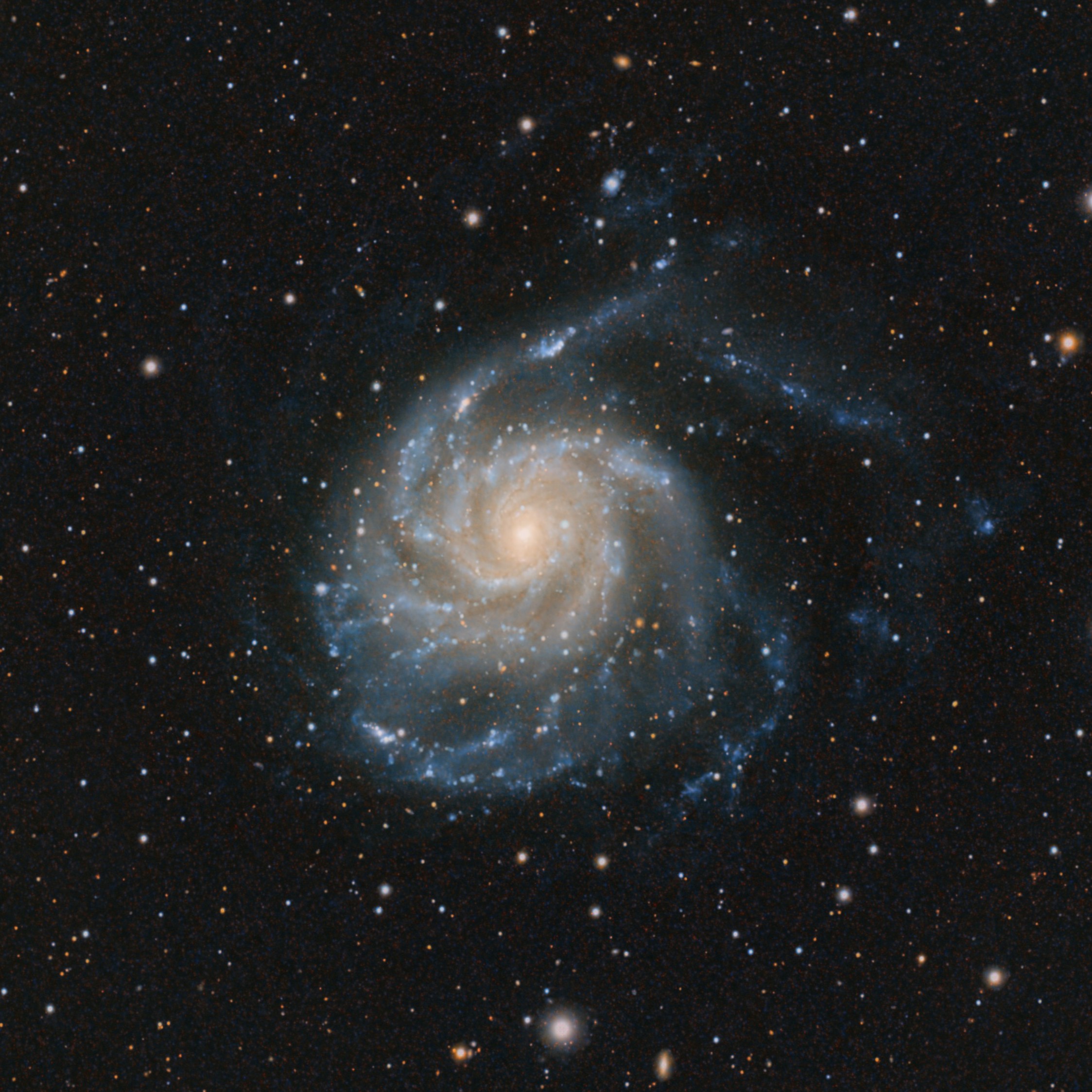
The Pinwheel Galaxy (Messier 101, NGC 5457) is a spectacular face-on spiral galaxy in the constellation Ursa Major, located about 21 ± 0.8 million light-years from Earth. With a vast diameter of around 170,000 light-years, it is almost twice as large as the Milky Way, making it one of the largest disk galaxies in our cosmic neighborhood. For astrophotographers, M101 is a combination of challenge and reward — its bright central region is easy to capture, but the faint, sprawling arms test both equipment and processing skills.
Basic Facts and Structure
- Type: SAB(rs)cd (loosely wound spiral with small bulge and rich arm structure)
- Diameter: ~170,000 light-years
- Mass: ~100 billion solar masses
- Right Ascension: 14h 03m 12.6s
- Declination: +54° 20′ 57″
- Apparent Magnitude: ~7.9
- Surface Brightness: ~14.8 mag/arcmin²
- Radial Velocity: ~241 km/s
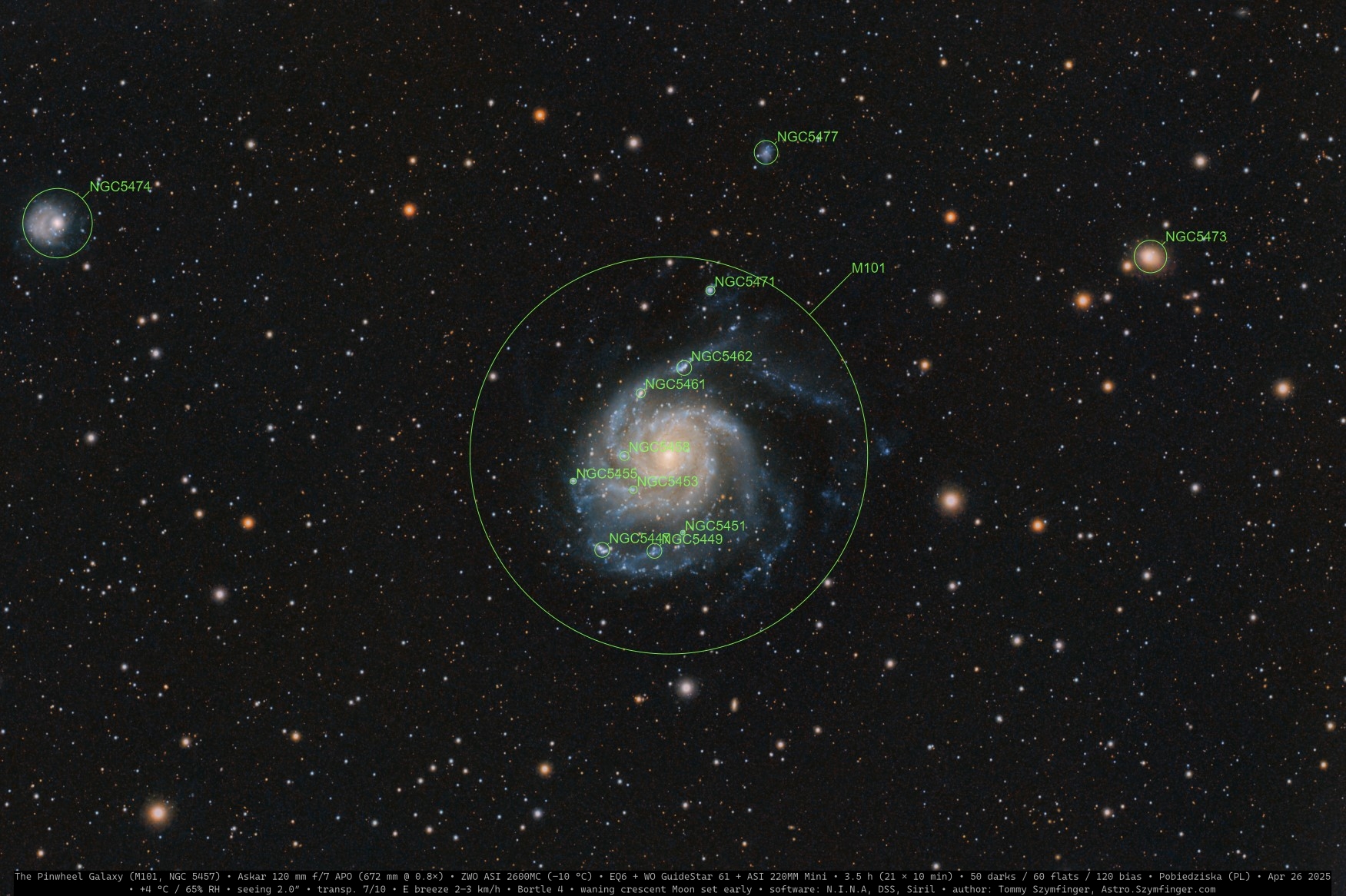
- Number of Satellite Galaxies: at least 7, including NGC 5474 and NGC 5477
M101’s loose spiral arms are packed with HII regions — giant clouds of ionized hydrogen where massive stars are being born. Some of these complexes exceed 1,500 light-years in diameter, large enough to dwarf entire dwarf galaxies. The galaxy’s asymmetric shape is the result of gravitational interactions with its smaller companions over the last several hundred million years.
Astrophotographic Challenges and Rewards
For astrophotographers, M101 offers a distinctive visual signature: a relatively bright core surrounded by faint, patchy arms dotted with star-forming regions. Its low surface brightness in the outer disk means that long total exposure times are key to revealing the full extent of its spiral structure. Narrowband Hα data can highlight the glowing nebulae embedded in the arms, while broadband RGB captures the contrast between the bluish young star clusters and the warmer, older stellar populations near the center.
Capturing the very faint outskirts of M101 is considered an advanced project — light pollution gradients and sensor noise easily mask these features, requiring careful calibration and post-processing.
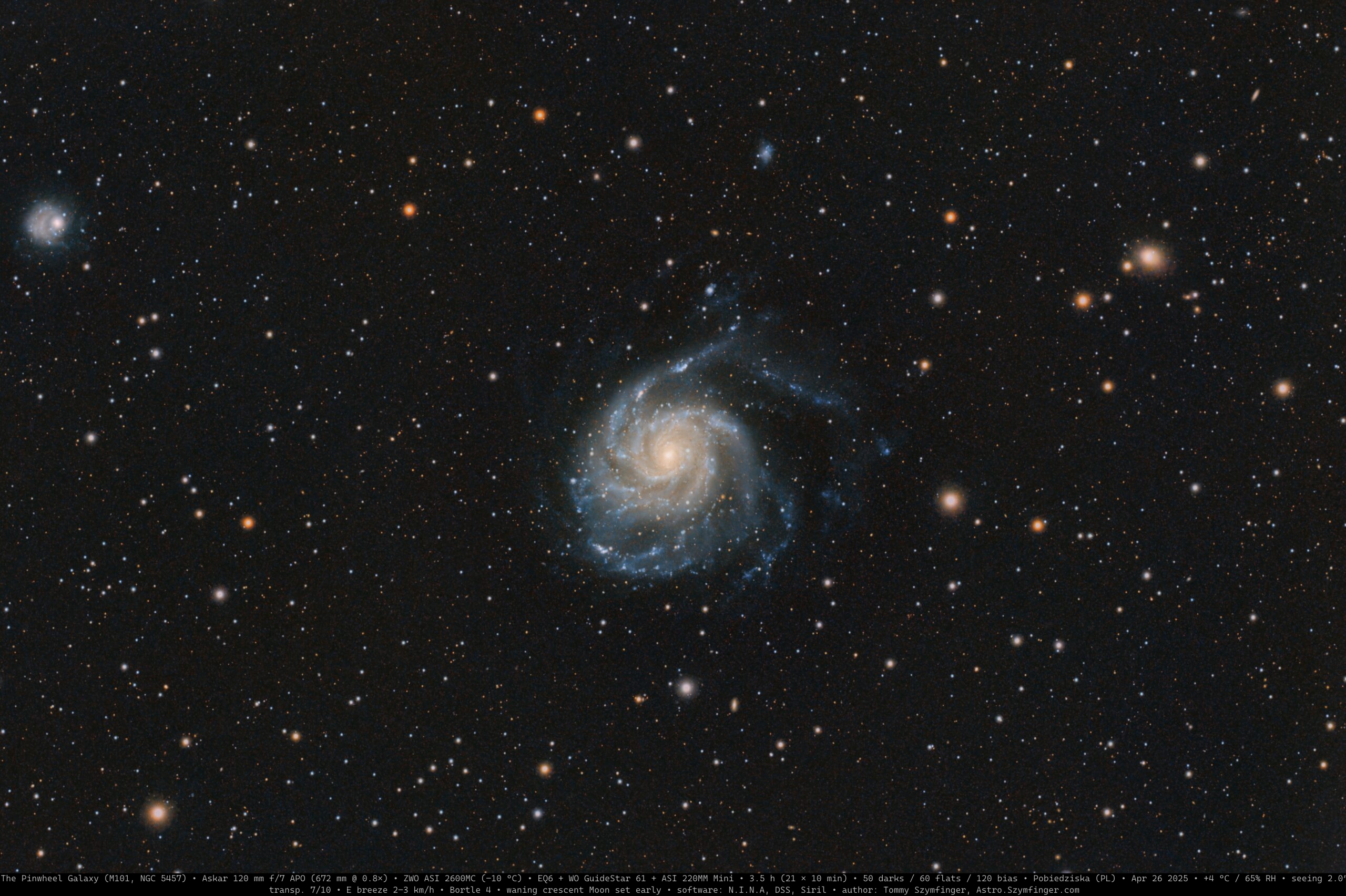
Imaging setup:
- Telescope: 120 mm f/7 apochromatic refractor with 0.8× reducer (effective focal length: 672 mm)
- Camera: cooled ZWO ASI 2600MC at –10°C
- Mount: EQ6-class equatorial mount with autoguiding via a 61 mm guide scope and mono guide camera ZWO ASI 220MM Mini
- Total Integration Time: 3.5 hours (21 × 10-minute subs) in a single night
- Calibration Frames: 50 darks, 60 flats, 120 bias
Session Details – Backyard Imaging of M101
This image was taken from my backyard observatory in Poland on April 26, 2025, during one of the first truly spring-like nights of the season. After sunset, the temperature gradually dropped to +4°C, with relative humidity around 65%. Seeing conditions measured about 2.0 arcseconds, while transparency was 7/10 — slightly reduced by a thin veil of high-altitude haze, but still allowing quality deep-sky work.
A gentle easterly breeze at 2–3 km/h kept the optics dew-free without causing vibration. The Moon, a thin waning crescent, set early, leaving a fully dark sky window for galaxy imaging under Bortle Class 4 conditions.
While 3.5 hours of integration is modest for a target like M101, the session produced a surprisingly satisfying result. The final stacked image captured the luminous core, intricate dust lanes, and numerous HII regions scattered across the spiral arms. Faint extensions in the outer disk were just visible after careful gradient removal, showcasing the galaxy’s vast scale.
Processing focused on preserving the fine granular texture of the arms while enhancing color contrast — bringing out the cool blues of young stellar populations and the magenta hues of ionized hydrogen clouds. Despite the shorter total exposure, the stability of the atmosphere and precise guiding allowed for a clean, high-contrast final image.
From a personal perspective, this session reinforced an important truth in astrophotography: while long integration is ideal, good sky conditions, optimized equipment, and disciplined processing can deliver excellent results even with limited total exposure time.
Scientific Relevance
M101 is a key object for astronomers studying:
- Spiral structure evolution — its asymmetry offers clues to tidal interaction effects.
- Star formation rates — the galaxy is home to over 3,000 catalogued HII regions.
- Metallicity gradients — M101’s outer arms have significantly lower heavy element content, offering insight into galactic chemical evolution.
- Supernovae — at least four have been observed in M101 over the last century, making it an important site for stellar death studies.
Observations from Hubble, Spitzer, and GALEX have mapped M101 across the electromagnetic spectrum, revealing a wealth of data about its stellar populations, gas dynamics, and dust distribution.
From a purely visual standpoint, M101 is a masterpiece of galactic architecture. But in astrophysics, it’s also a laboratory for understanding the interplay between star formation, galactic dynamics, and environmental interactions — the same processes that have shaped our own Milky Way.