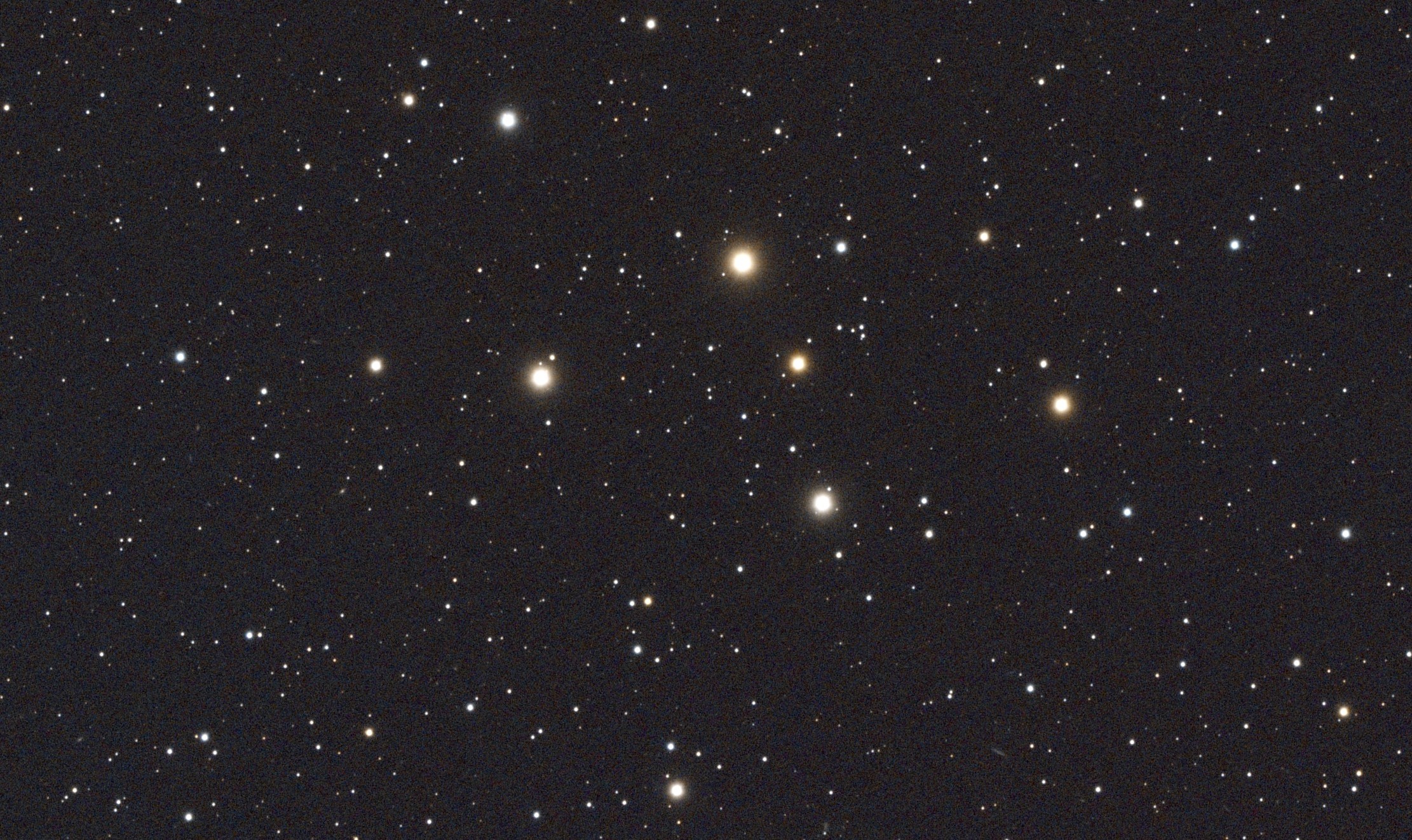
Kemble 2 – a stellar chain in Cygnus
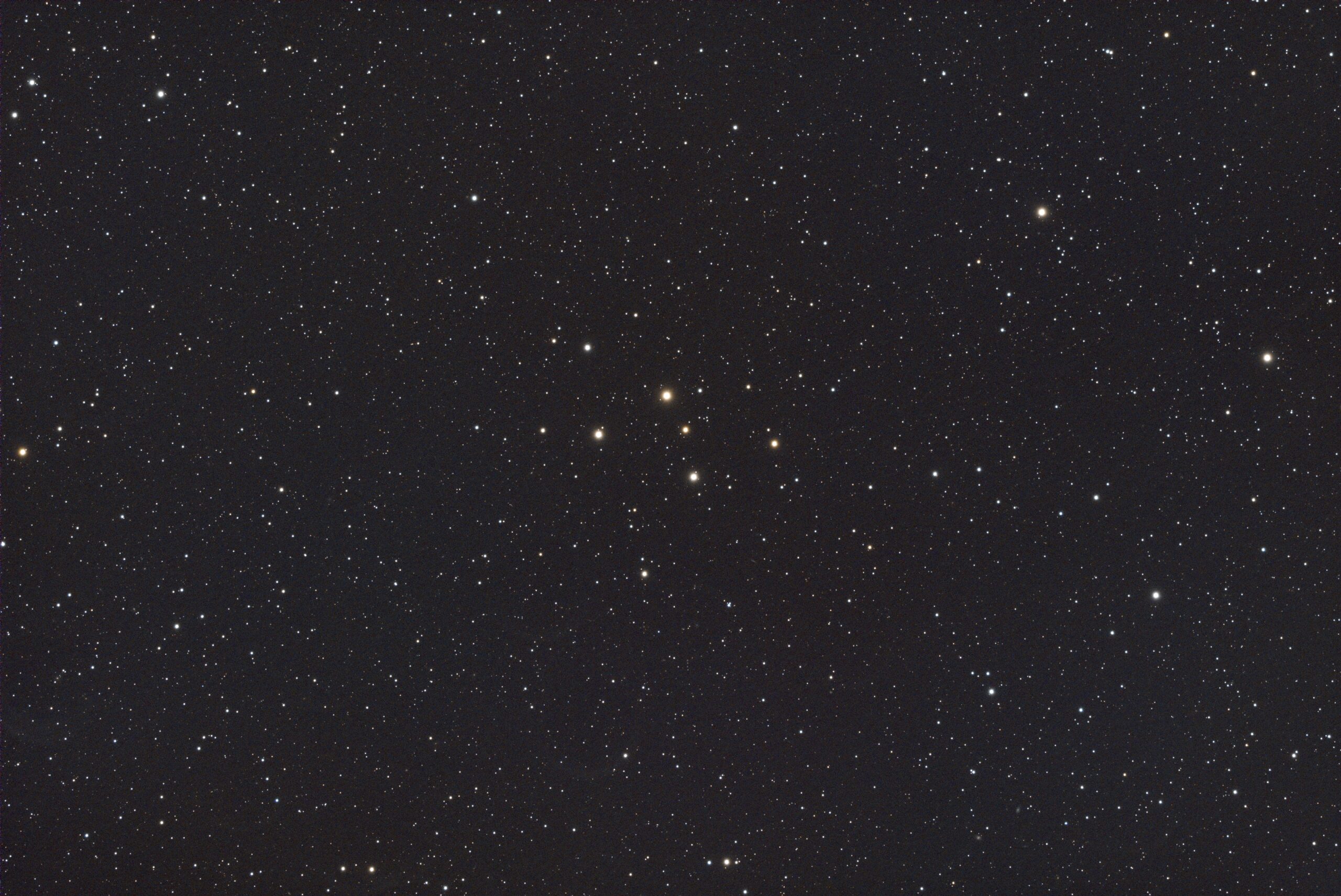
This session was focused on capturing one of the more visually intriguing stellar patterns in the Cygnus constellation, known as Kemble 2. It is not a star cluster or a cataloged deep-sky object in the classical sense. Instead, it is a chance alignment of stars within the Milky Way that, from our point of view, forms a linear chain.
The region lies in a very dense star field, which introduces specific challenges during both acquisition and processing. High stellar density means that even small tracking errors, focus imperfections, or calibration issues become immediately visible. At the same time, it is easy to overprocess such data and lose the natural structure of the field.
The central part of the frame is dominated by several brighter stars with a warm, yellowish tone. These are primarily G- and K-type stars. Although they appear visually connected, they are not physically related. Each star lies at a different distance, and the apparent structure is purely a line-of-sight effect.
Session Details
Object: Kemble 2 (Asterism)
Constellation: Cygnus
Coordinates: RA 18h 34m / DEC +72° 22′
Equipment
Telescope: Askar 120 APO
Focal Length: 672 mm (0.8× reducer)
Focal Ratio: f/5.6
Camera: ZWO ASI 2600MC (one-shot color CMOS)
Mount: Sky-Watcher EQ6-R Pro
Guiding: William Optics Guidestar 61 with ZWO ASI 220MM Mini
Autofocus: ZWO EAF
Control Software: N.I.N.A.
Acquisition Parameters
Total Integration Time: 4860 seconds (1 hour 21 minutes)
Number of Frames: 81
Exposure Time: approximately 60 seconds per frame
Gain: 100
Cooling: actively stabilized sensor temperature
Dithering: enabled
Filters: none, full spectrum capture
Sky Conditions
Bortle Scale: class 4
Sky Brightness: approximately 20.58 mag/arcsec²
Seeing: moderate
Transparency: good
Calibration Frames
Dark Frames: matched to exposure time and temperature
Flat Frames: applied
Bias Frames: applied
Processing Workflow in Siril
OSC preprocessing script
Calibration using dark, flat and bias frames
Registration of all frames
Stacking with average integration and winsorized sigma clipping
Background extraction using RBF interpolation
Background neutralization
Color calibration using stellar reference
Green noise reduction using SCNR
Manual histogram stretch
Subtle saturation adjustment
Final Notes
The final image preserves the natural appearance of a dense Milky Way star field, with subtle color differences between stellar types. No aggressive noise reduction or contrast enhancement was applied. The goal of this session was to capture the visual geometry of an asterism and the depth of the stellar background.
Kemble 2 highlights how perceived structure in the night sky is often a result of perspective rather than a true physical system.