
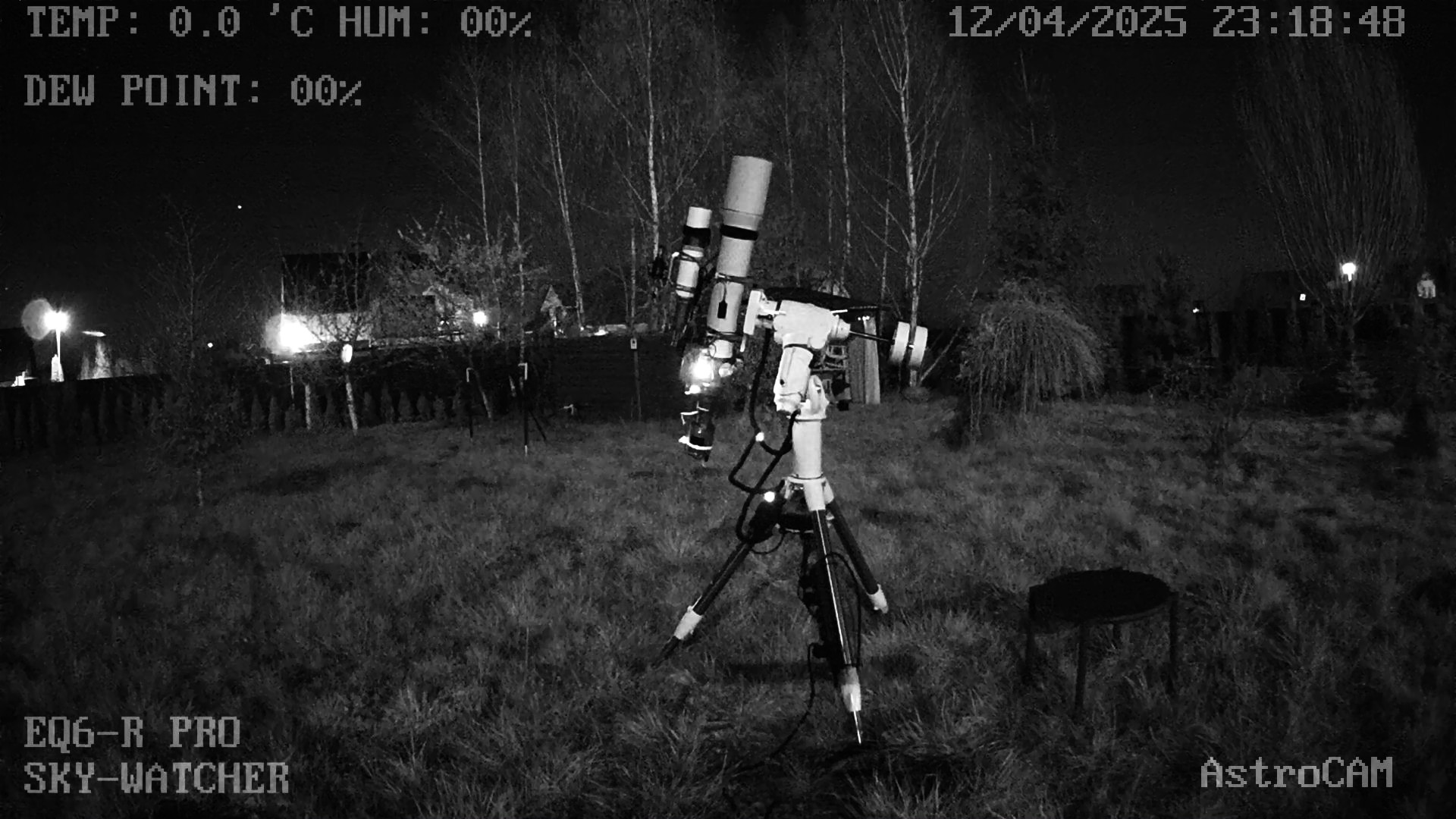
My Astrophotography Equipment Overview
The astrophotography setup is built around a high-performance imaging system designed for both deep-sky and planetary observations, ensuring precision tracking, optimal optical performance, and automated workflow management.
- Primary Imaging Telescope:
- Model: Askar 120 APO refractor
- Focal Length: 840 mm at f/7 with 1.0× field flattener; 672 mm at f/5.6 with 0.8× reducer
- Optics: Apochromatic triplet design for superior color correction and sharpness
- Accessories: Precision-machined extension tube for mounting stability
- Mount:
- Model: Sky-Watcher EQ6-R Pro
- Features: GoTo equatorial mount with high payload capacity, belt-driven for reduced periodic error
- Enhancements: Elevation riser/tube for optimal balance and clearance
- Guiding System:
- Guide Scope: William Optics Guidestar 61 GD APO
- Guide Camera: ZWO ASI 220MM Mini (monochrome) for high-sensitivity autoguiding
- Imaging Camera:
- Model: ZWO ASI 2600MC (APS-C color CMOS)
- Cooling: Two-stage TEC cooling for low thermal noise
- Sensor: Sony IMX571 with 16-bit ADC, high quantum efficiency, and zero amp glow
- Focusing:
- ZWO EAF (Electronic Automatic Focuser, 5 V USB version, with temperature probe) for precise and repeatable autofocus adjustments
- Power & Control Systems:
- Power Management: Wanderer Power Box V3 PRO for centralized power distribution to all devices
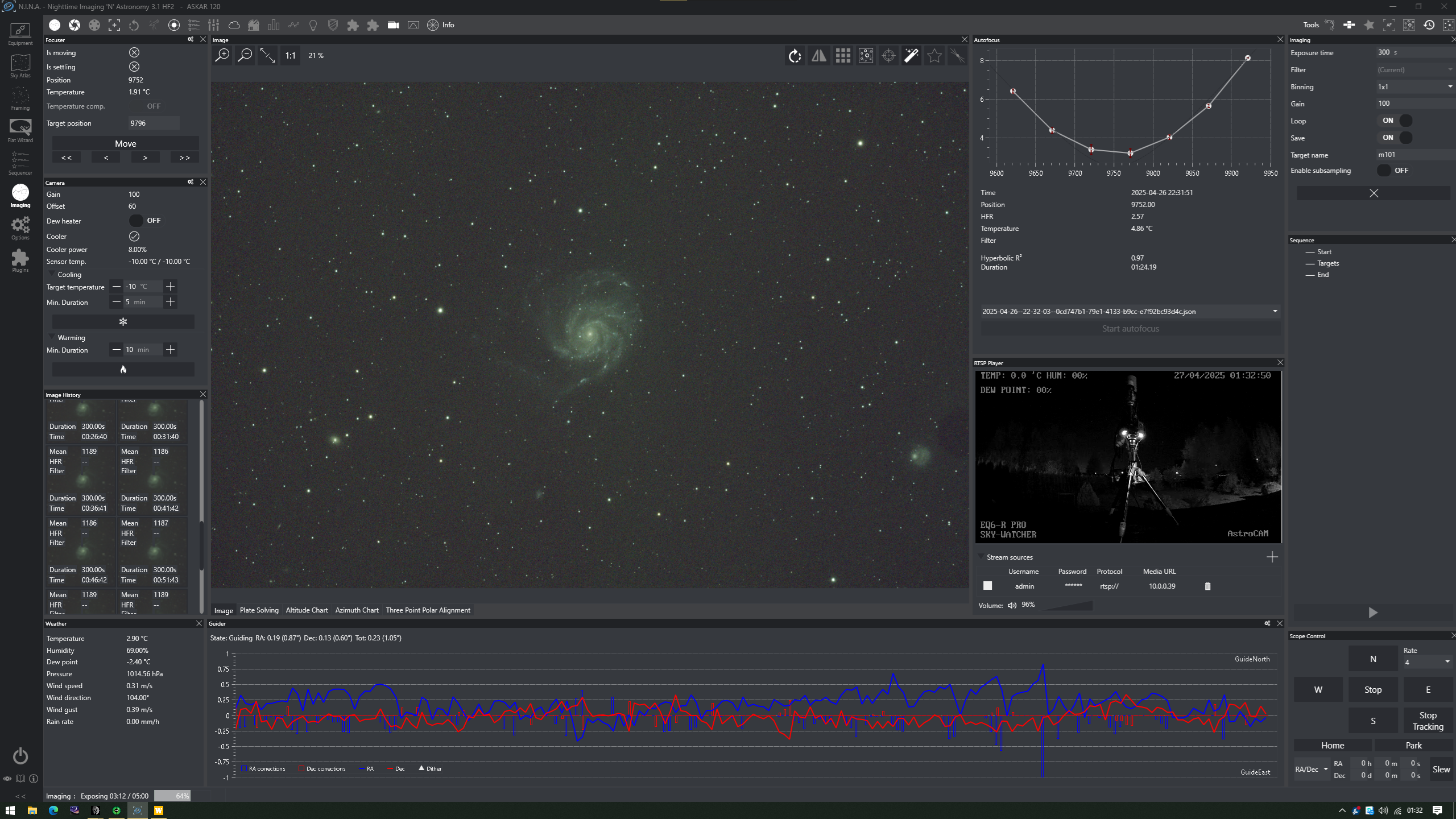
- Control Computer: Intel NUC 12 (model NUC12WSKI5) with 2 TB NVMe SSD and 32 GB RAM running N.I.N.A. for automated sequencing and imaging control
- Additional Accessories: WandererEmpire software for device integration and power management
- Dew Control:
- AstroJolo heating bands (12 V/USB, sizes 100–130 mm and 70–90 mm) for both main and guide optics, ensuring dew-free operation during long sessions
- Environmental Conditions:
- Typical observing site offers a sky brightness of 20.58 mag/arcsec², corresponding to Bortle Class 4 skies
This configuration delivers a balanced combination of optical quality, tracking accuracy, and automation, enabling high-resolution astrophotography with minimal manual intervention. It is optimized for extended exposure deep-sky imaging while retaining flexibility for shorter planetary sessions.
ZWO Seestar S50 – Portable Smart Astrophotography Telescope
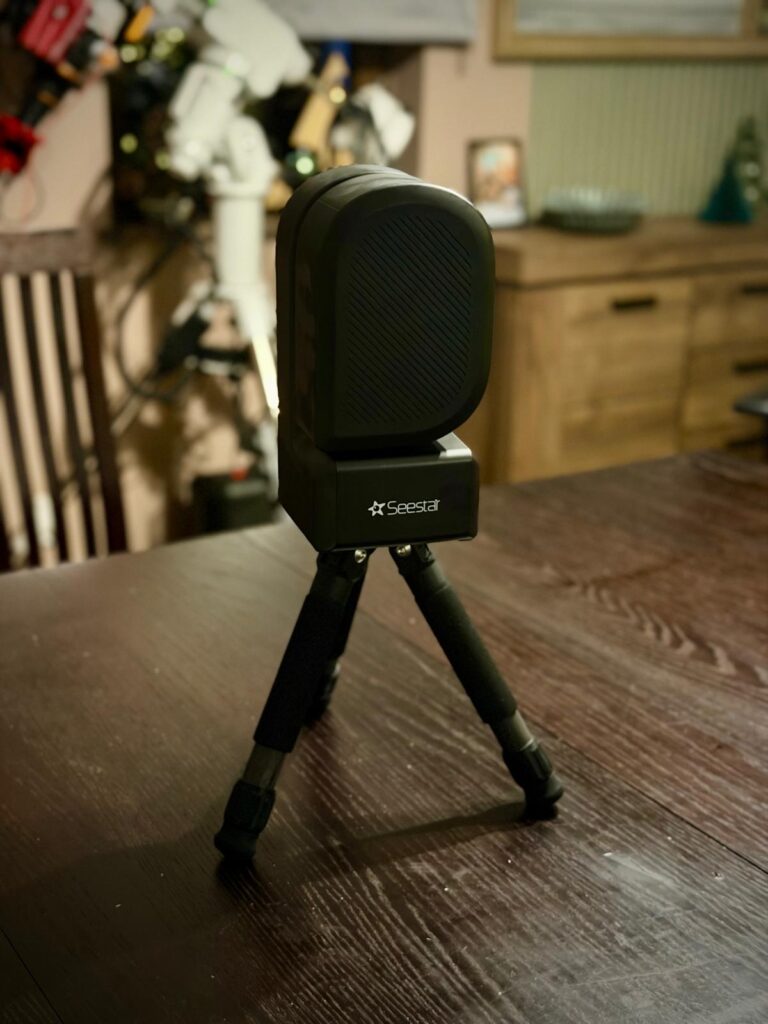
The ZWO Seestar S50 is a compact, fully integrated smart telescope designed for fast, automated astrophotography with minimal setup and maximum portability. Unlike traditional modular rigs, the Seestar S50 combines optics, sensor, mount, tracking, and live stacking into a single, self-contained unit controlled entirely via a mobile application.
With a 50 mm apochromatic refractor, 250 mm focal length (f/5), and a Sony IMX462 CMOS sensor, the Seestar S50 is particularly well suited for wide-field and medium-scale deep-sky objects such as emission nebulae and large galaxies. Despite its small aperture, it is capable of delivering surprisingly usable data, especially when integration time is optimized and external post-processing is applied.
One of its key strengths is real-time live stacking with automatic alignment and tracking, allowing objects to gradually emerge on screen within minutes. This makes it not only an imaging tool, but also an excellent device for live observing, outreach, and educational use. Data can be processed directly in the ZWO Seestar app for quick results, or exported for manual processing in software such as Siril.
The Seestar S50 is not intended to replace a full-scale astrophotography setup, but rather to complement it. Its true value lies in situations where mobility, speed, and simplicity matter most. It is an ideal solution for field sessions, small astrophotography meetups, travel, holidays, and spontaneous observing nights, where deploying a full rig would be impractical.
As a grab-and-go system, the Seestar S50 significantly lowers the barrier to entry into astrophotography while still offering enough image quality and data integrity to remain interesting and useful for experienced astrophotographers.