
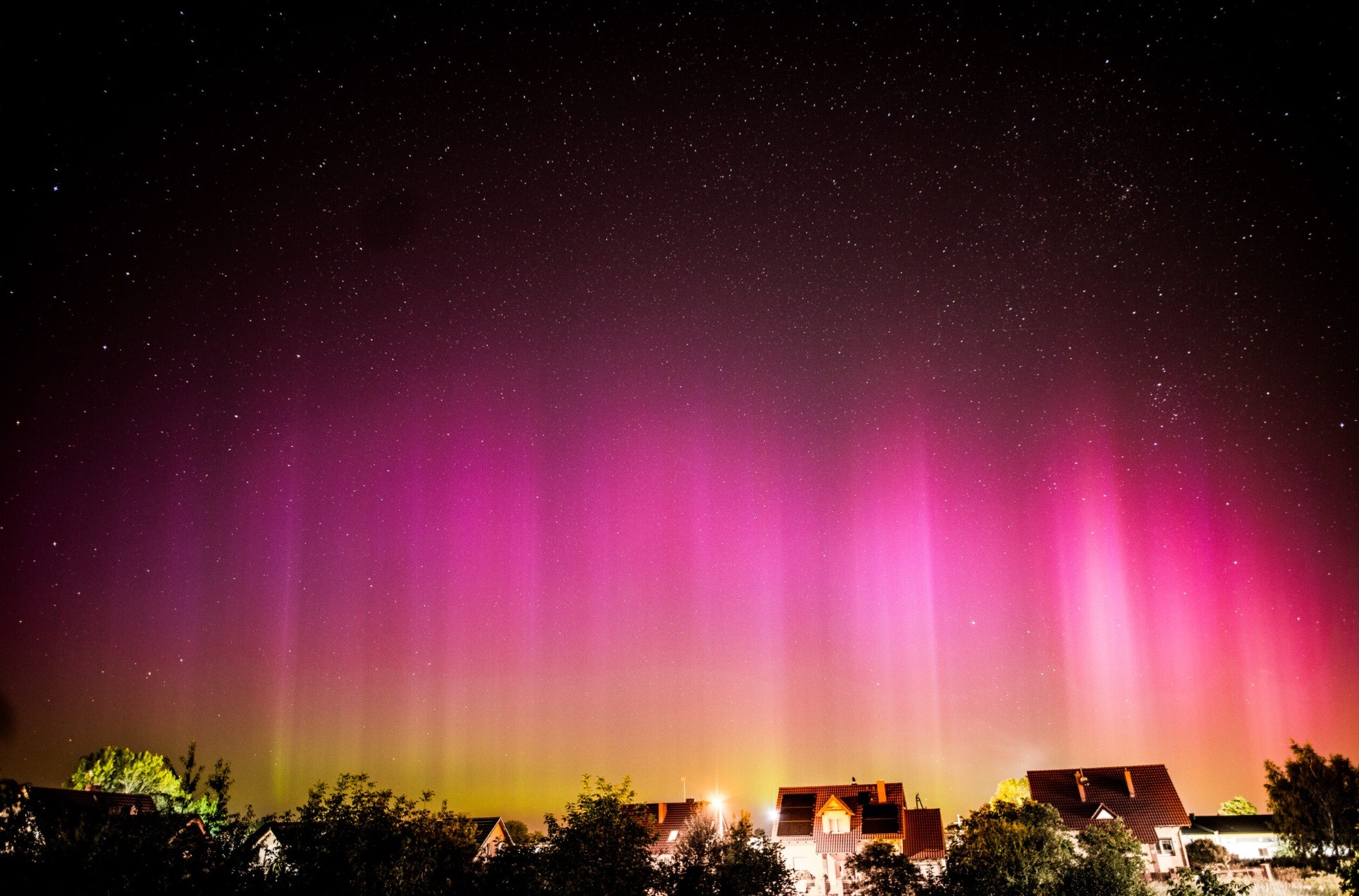
The Northern Lights, or Aurora Borealis, are usually reserved for the skies of high-latitude regions such as Norway, Iceland, or Alaska. Yet on the night of August 12, 2024, this rare and magical phenomenon appeared far to the south — visible even in Poland. A powerful geomagnetic storm, triggered by intense solar activity, brought shimmering curtains of green, pink, and red light to the night skies over much of Europe.
Aurora Borealis over Poland – August 12, 2024
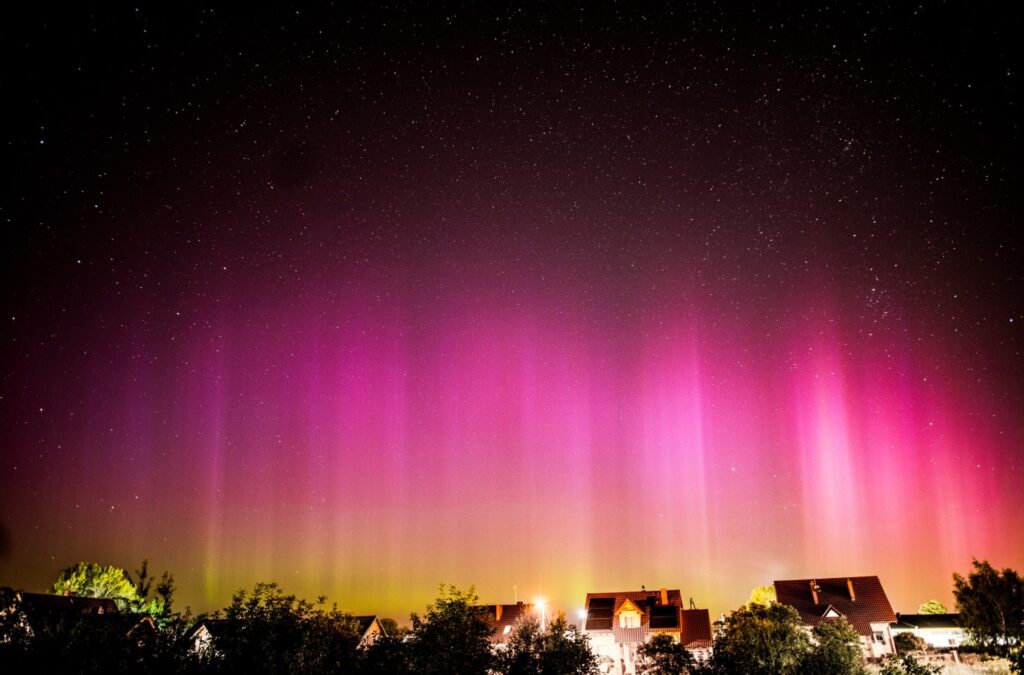
Sigma Lens 20 mm A 20/1.4 DG HSM
Edit: Light Room
The Event
On that evening, auroras were reported across Poland, Germany, the United Kingdom, and even parts of central Europe, far outside their usual geographic range. The extraordinary visibility was caused by a strong coronal mass ejection (CME) from the Sun, which interacted with Earth’s magnetic field and pushed auroral activity well below the Arctic Circle.
Millions of people who had never seen the Northern Lights before were able to witness this stunning natural display — an unforgettable event that lit up social media and made headlines worldwide.
Aurora Science
Auroras occur when charged particles from the solar wind are guided by Earth’s magnetic field toward the polar regions. As these particles collide with molecules in the upper atmosphere, they emit light in characteristic colors:
- Green and pink – from oxygen at ~100 km altitude.
- Red – from higher-altitude oxygen at 200–300 km.
- Purple and blue – from nitrogen interactions.
The auroras on August 12th exhibited all of these shades, forming dynamic arcs, flowing curtains, and bright rays that danced rapidly across the sky.
Imaging the Aurora
This rare display was captured using:
- Camera: Nikon D610 (CMOS)
- Lens: Sigma Art 20mm f/1.4 DG HSM
- Editing: Adobe Lightroom
The wide field of the 20 mm lens allowed for expansive views of the sky, while the fast aperture (f/1.4) enabled short exposures that preserved the motion of the auroral curtains without excessive star trailing. Post-processing in Lightroom enhanced the natural color balance and contrast, highlighting both the delicate green glows and the rarer red and purple tones.
Personal Impression
Seeing the aurora overhead in Poland was nothing short of surreal. The sky seemed alive — pulsing, rippling, and glowing with colors that most people only dream of seeing. For an astrophotographer used to galaxies and nebulae millions of light-years away, capturing such a dynamic natural phenomenon in real time was a completely different but equally humbling experience.
And now, let’s dive a bit into the theory…
Auroras are not only beautiful; they are also an important reminder of the Sun’s influence on Earth. Strong geomagnetic storms like the one in August 2024 can disrupt satellites, GPS, and even power grids. But for observers on the ground, they also deliver one of nature’s most unforgettable light shows — a spectacle that connects us directly with the dynamic forces of our solar system.